Blog

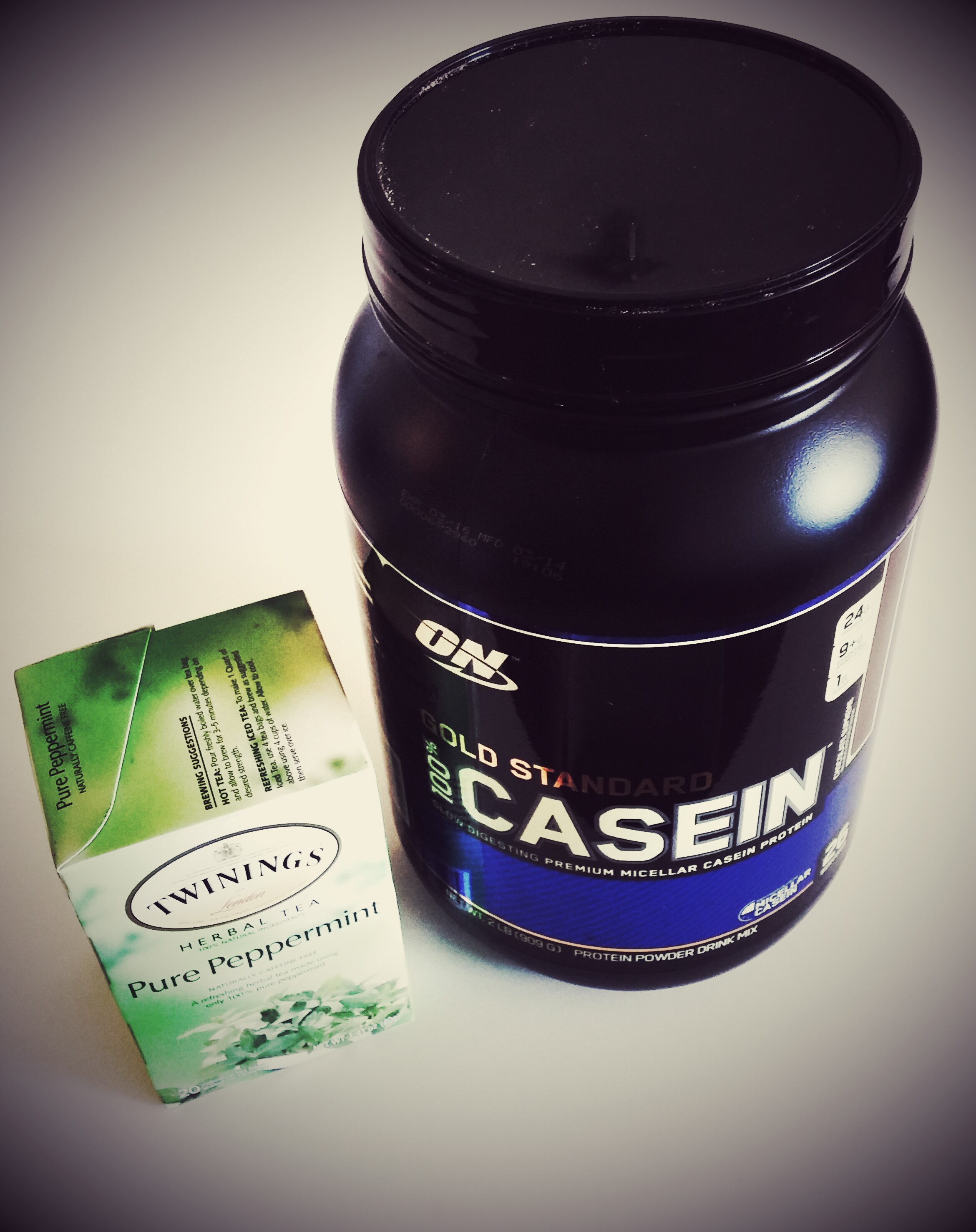
Ripped Recipe: Ripped Mint Hot Cocoa

Super simple, tasty and proteiny.

Super simple, tasty and proteiny.

This one is so simple. I felt like a genius for a minute after creating it.

Ingredients
3/4 scoop chocolate casein powder
1 peppermint tea bag
10 oz boiling water

Preparation
Mix casein with a couple of oz warm tap water. Mix it well so there are no clumps. Slowly add boiling water while stirring rapidly. Steep mint tea bag in mixture for 3-5 mins depending on how strong you want it. Drink.

Ripped Recipe: Cabbage Leaves Stuffed with Beef, Pork, Plum, Apple, Walnut, Vegetable and Mint Topped with Sweet and Savory Tomato Coconut Sauce

Look good? This dish combines North African,  Greek, Italian and Polish flavors.

Look good? This dish combines North African, Greek, Italian and Polish flavors.

I was standing in the grocery staring off into space trying to figure out what big thing to cook for dinner this week. I looked down and realized that I was literally standing over it. A giant head of green cabbage. That’s all I needed to get the creative juices flowing.

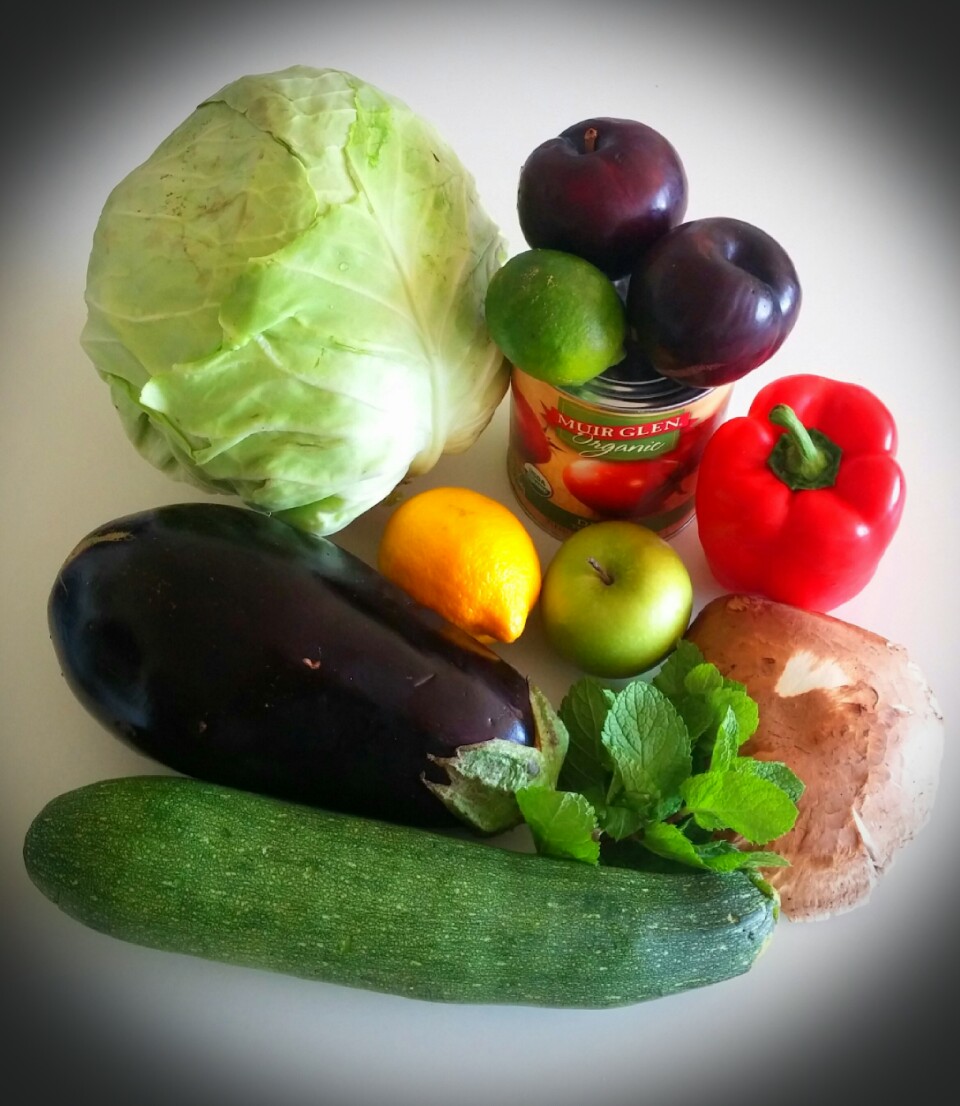
Some of the ingredients used in this tasty dish.

Some of the ingredients used in this tasty dish.

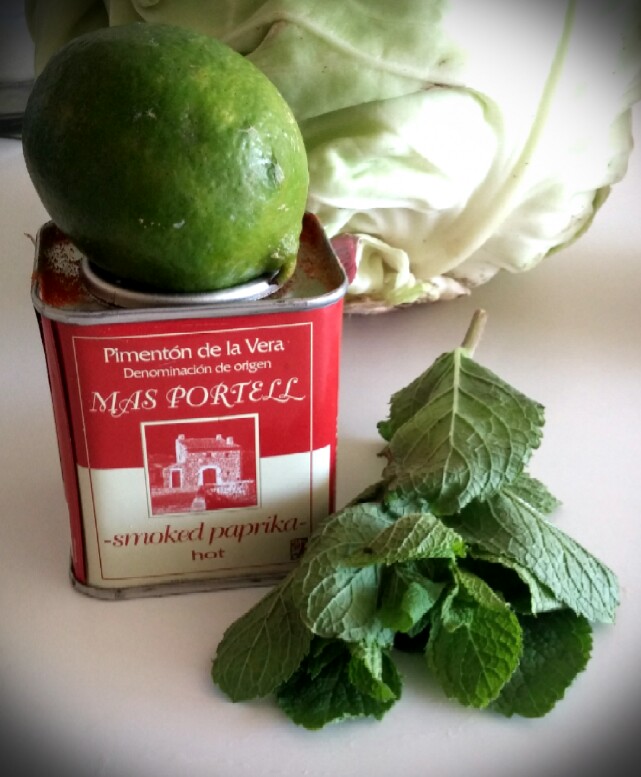
An unlikely trio.

An unlikely trio.

Ingredients
1 lb ground beef (90/10, organic grass fed preferably)
1.5 lb ground pork (ground local by butcher, preferably)
2 large heads green cabbage
650g eggplant, diced (1 large)
500-600g zucchini, diced (2 large)
250g carrots, diced (6 medium, I use organic)
350g sweet onion, diced (1 large)
250g portabella mushroom, diced (2 large, I use organic)
200g red bell pepper (1 large, I use organic)
300g black plums, diced (2 large)
200g granny smith apple, diced (2 small or 1 large)
2 cups uncooked jasmine rice
3 cups unsalted chicken stock
1 large can (28oz) ground tomatoes (I use organic)
1 small can (13oz) lite coconut milk
1 cup walnuts, chopped
1 cup mint leaves, chopped
3/4 cup or so grated hi quality strong romano cheese
juice of 1 lime
3 Tbsp brown sugar
3 Tbsp ketchup
2 Tbsp dried sweet basil
2 tsp smoked hot paprika
2 tsp regular paprika
2 tsp cinnamon
2 tsp garlic powder
3 cloves garlic, minced
1/4 cup arrowroot starch
salt and fresh pepper

Get your veggies straight.

Get your produce straight.

Preparation

  1. Chop base off cabbage(s) and remove core to around 2″ up (cut a pyramid around core to remove). Boil until soft and the leaves can be easily pulled off. Yeah, boiling kills the vitamins, but this ain’t about the cabbage.
  2. While cabbage is boiling, pour a little coconut oil and start the onion cooking until light brown then add garlic. Once garlic is light brown, add eggplant, cooking on high, stirring frequently. Once eggplant is about half its original volume, add mushrooms and continue cooking. When mushrooms are about half volume, add zucchini. The idea is to get a good deal of water out of the vegetables.
  3. When zucchini is around half its original volume, add plums and apples. Cook for a few minutes, then add beef and pork.
  4. Lightly cook beef and pork with the vegetables that were already in the pot for another 4-5 minutes. This is to reduce cooking time in the oven. Season with kosher salt and pepper.
  5. Add carrots, bell pepper, walnuts, chopped mint, cinnamon, both paprikas, lime juice, garlic powder, more salt and pepper and mix well. Turn off heat.
  6. Cook rice in 3 cups of stock. It should still be chewy once all liquid has been absorbed. Add it to the meat and veg mixture; it will finish cooking in it later.
  7. you might want to cook a little of the mix in the microwave for a minute to taste test and adjust if necessary.
  8. For sauce, combine coconut milk, ground tomatoes, ketchup, brown sugar, white vinegar and basil. Heat until it comes to a simmer. Add arrowroot slurry (arrowroot mixed well with a little warm water). Turn off heat and mix well.
  9. Wrap meat/ veg/ rice mixture in cabbage leaves. Shave center veins of leaves so they’re not so thick.
  10. Place stuffed cabbage leaves in baking dish, cover liberally with sauce, top with grated Romano. Cover with foil.
  11. Bake at 375 for 30, then uncover and let go for another 20. Let cool for 5 mins or so. Eat.
We ain't messin around.   This is many meals for a family of three.

We ain’t messin around. This is many meals for a family of three.

Ripped Abs Without Crunches, Cut Biceps Without Curls

All individuals have different goals. Some are more interested in developing massive strength, and less so in maintaining a ripped physique (e.g. powerlifters), while others are more interested in growing and specifically shaping individual muscles, while being less concerned about strength (e.g. bodybuilders). My interests have gravitated toward a hybrid of those, i.e. developing both the strength and physique I wanted as efficiently as possible.

For me, getting ripped became legitimately effortless once I understood how effortless it could be. Sort of a circular statement, I know, but it’s true. I also know from experience that it can also be excruciatingly difficult if it’s made to be that. I’ve noticed that my overall health and general physique flourish when I stress myself just enough, then stop long before I’m spent, and rest even when I feel I don’t need it. This is one of the reasons I dropped structured cardio almost completely out of my life several months ago.

To these points, I figure why bother with exercises that target only one thing, like crunches or biceps curls? I see many gym goers performing lots of these types of exercises; these are clearly two really popular muscle groups to isolate, so much that it sort of cliché. I don’t know what the goals of these individuals are, and I pass no judgement on why they’re doing what they’re doing, but my best guess is that they probably want definition and/ or growth in those areas. But for my particular goals though, there are a few big problems with isolating muscle groups like this.

Abs with zero direct ab work.

Abs with zero direct ab work.

Muscular balance is upset [functional fitness suffers]
I developed imbalances in my overall musculature when attempting to stress individual muscle groups, and even experienced impingement in certain areas as a result of the impossibility of applying loads in the right ratios to antagonizing muscle groups in isolation. Take a hamstring curl, for example. When ever during the course of real life would the hamstrings be isolated to that extent? There is literally no natural motion that isolates the hamstrings the way a very unnatural leg curl does. You can look at it from the other side too: an individual who favors leg extensions (either intentionally or unintentionally) to the point where the quads become more powerful than they should in relation to the rest of the lower body musculature, can develop a painfully tight lower back and lordosis. Chances are exceptionally high that if one major muscle group in the lower body is firing during a real life motion, the rest of those groups are as well. This is why it makes sense to me to almost exclusively perform compound exercises with a barbell, like squats, deadlifts, bench presses, and other fixed bar exercises like weighted chinups, pullups and dips.

Biceps without a single curl.

Biceps without a single curl.

Isolation takes too long
Two exercises for the biceps, two for the deltoids, three for the back, three for the chest, one for the abs… oh wait, make that two cause I gotta hit those obliques. Oh crap, lemme get my traps in there also, so one for that. I forgot triceps. I’ll add two exercises for those. This is pretty much the way I used to lift weights. I’ve written fairly extensively on the main pages of rippedforever.com about why it was so absolutely pointless for me. Now, if I perform 3-5 sets of close grip heavy weighted chinups, I hit the biceps, lats, abs (lots of isometric work during a heavy chinup), traps, rhomboids and posterior deltoids. And as a bonus, if I squeeze all the way to the top of the motion range, I get hard pectoral work. Five sets of five reps of very heavy chinups takes maybe eight minutes. That plus some heavy front squats and deadlifts can easily be a complete and very effective workout completed in 40 minutes.

Isolation doesn’t develop strength
At least not nearly to the same extent that heavy compound lifts can. Compound lifts tax the central nervous system in a big way like nothing else can. A shoulder raise can’t do that. Neither can a calf raise. Nor a shrug. Reverse curl? No way.

Isolation has a place
None of the above is to say that I think isolation or working smaller muscle groups is worthless. I can’t say that, because many individuals find them very valuable and critical to their own goals. They’re just not relevant to my goals, and they absolutely are not a requirement for getting ripped and staying ripped.

Ripped Recipe: Garlicked Red Cabbage with Bacon and Raisins over Steamed Kabocha Squash

This is good. Very good. Sometimes I feel like eating a mountain of vegetables, and this is one way I do it.

You can basically eat 2 lbs of this and not break 500 calories.

You can basically eat 2 lbs of this and not break 500 calories.

Ingredients
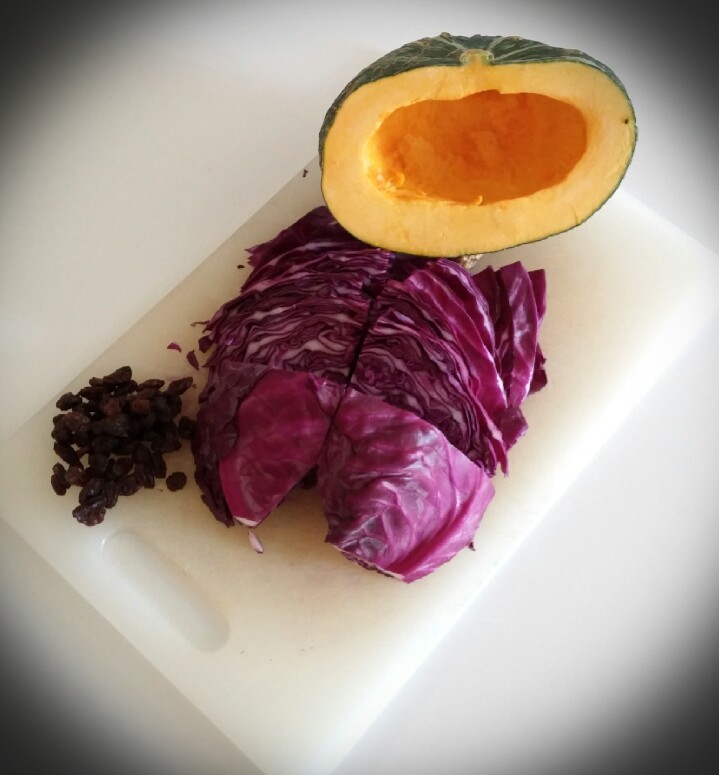
1/2 large head red cabbage, sliced into 2-3 inch strips
1/2 Kabocha squash
4 slices bacon (I like uncured organic)
1/4 cup or so raisins
2 cloves garlic minced
2 tsp high quality garlic powder
1/2 shallot, diced
2 Tbsp apple cider vinegar (I like unfiltered organic)
Kosher salt and fresh cracked pepper

Preparation

  1. Cut kabocha squash in half. Gut. Peel. Cut into cubes. Put on to steam. It’s done when fork tender, maybe 15 mins or so.
  2. As squash is steaming, in a large pan cook bacon crispy. Set aside on paper towel once cooked. Reserve fat from pan in small vessel.
  3. Turn flame to high. Add shallots and garlic. Add a teaspoon or so of bacon fat. Cook until the garlic takes on a light golden hue.
  4. Add cabbage and raisins. Salt liberally to draw water out of cabbage. Cook over high heat for another minute and stir. Lower heat, add garlic powder, apple cider vinegar, fresh pepper to taste, and cover.
  5. Cook until cabbage is tender. Normally 15 mins or so.
  6. Coarse chop bacon, sprinkle half into cabbage and stir.
  7. Place kabocha in bowl, sprinkle with salt and pepper. Top with cabbage. Sprinkle remaining bacon on top.
This is very special. Eat it.

This is very special. Eat it.

Stew Cylinders: How to Accurately Calculate Servings, Calories and Nutritional Content in Recipes

Generally, I have no trouble tracking calories and nutrients I consume thanks to MyFitnessPal, which is a neat little application (Android/ iOS/ web) that basically does everything for you. It’s powered by an absolutely enormous food database. All that’s required of the user is to search for a food, enter the number of servings and submit. The process takes all of two or three seconds once you get into the swing of things. It’s easy enough to track the consumption of discrete food items, like grilled chicken breast or a tablespoon of coconut oil or 200g of sweet potato (so long as you have a food scale or are good at estimating). But things can get tricky when attempting to calculate the number of calories and nutrients in a recipe and even trickier when calculating the portion size of that recipe you might have consumed.

This is the whiteboard cling on the side of my fridge where I track recipe ingredient weights.

This is the whiteboard cling on the side of my fridge where I track recipe ingredient weights.

For example, I might make a huge pot of stew, then eat a bowlful of it, but how do I know how much I’ve consumed? Well, for one, I could measure out a couple of cupfuls of stew into my bowl, but how do I know how many calories and macros are in those two cups? I’d need to know two other things: 1) how many calories and macros the whole pot contained, and 2) how many cups of stew are in the pot. That second part is actually a lot trickier than it sounds, especially when it’s a huge, hot pot of stew that I might not be inclined to measure out cup-by-cup into another pot to determine how many cups I’m starting with. So what to do? Here’s the process I follow; although it might seem complicated on first read, I promise it’s not in practice:

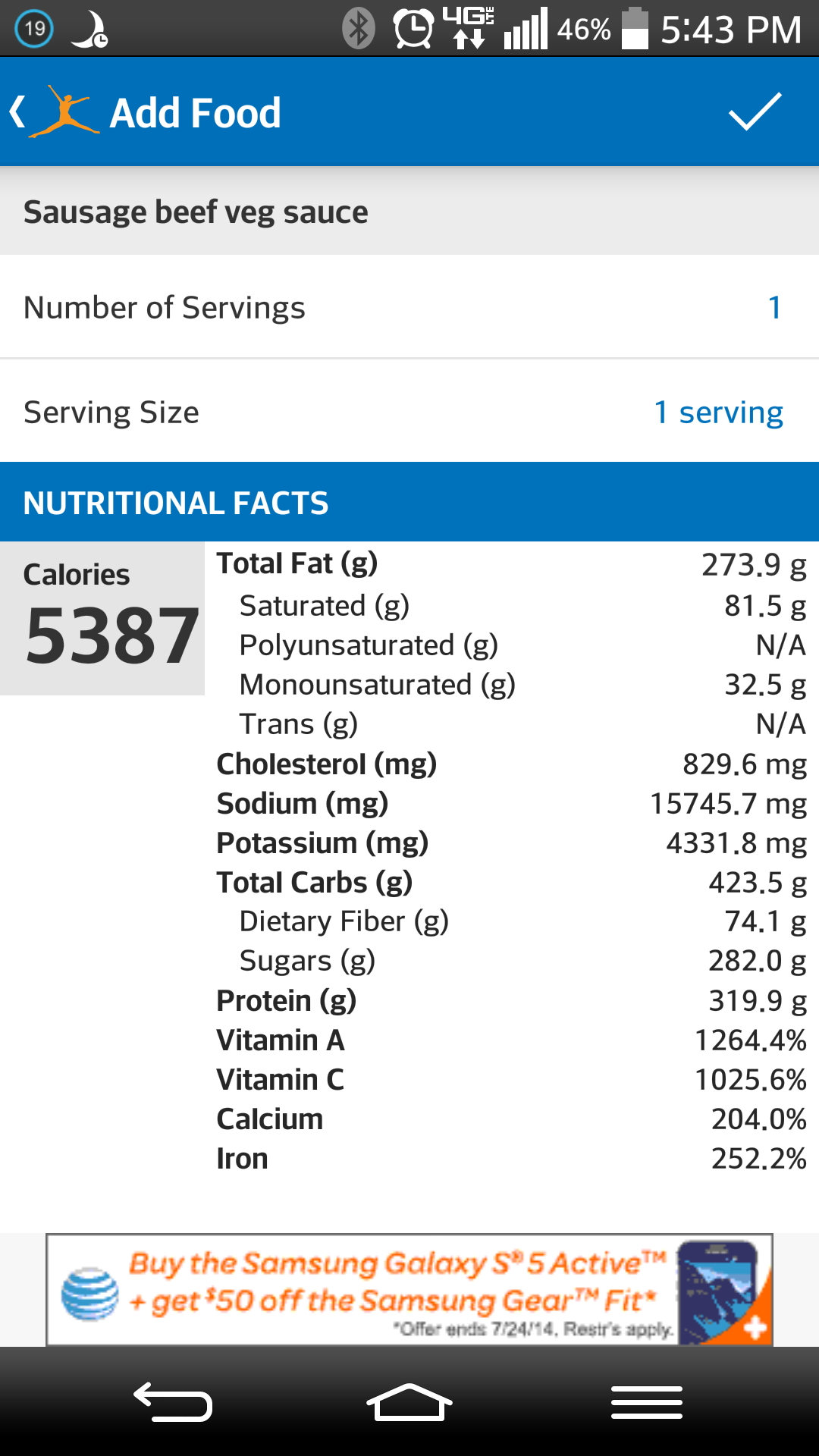
  1. MyFitnessPal includes a function that allows recipes to be created that are comprised of multiple food items. It also requires the user to enter the number of servings the recipe makes. Since I never know this (I make up recipes as I go), I always tell the app that it makes ONE serving. I’ll explain why in a minute. I then weigh out all the items in the recipe and enter them into the app. Once the recipe is created, the app generates a nutrition table for it that lists calories, macros and some vitamins/ minerals. Since I’ve indicated that the whole pot is a single serving, the table might show me something like “5,387 calories per serving.”

    A recipe profile in MyFitnessPal. Note that I have this set as a single serving.

    A recipe profile in MyFitnessPal. Note that I have this set as a single serving.

  2. Now I have to figure out how many cups are in the pot of stew. I could, of course just estimate. If I know my pot holds eight quarts I can come up with a reasonable estimate. But sometimes reasonable isn’t good enough, especially if what I’ve made is very energy dense. If I’m off by a few cups (which is likely), that can significantly throw off my individual serving calculations. To get an accurate answer, I first measure the depth of the food in the pot with a ruler (either on the inside with a plastic ruler I’d only use for this or on the outside of the pot). Say it’s six inches deep. Then I measure the interior diameter of the pot; say that’s nine inches. Since the pot is a cylinder, then so is the stew inside it. So now I know I have a cylinder of stew that six inches high by nine inches in diameter.
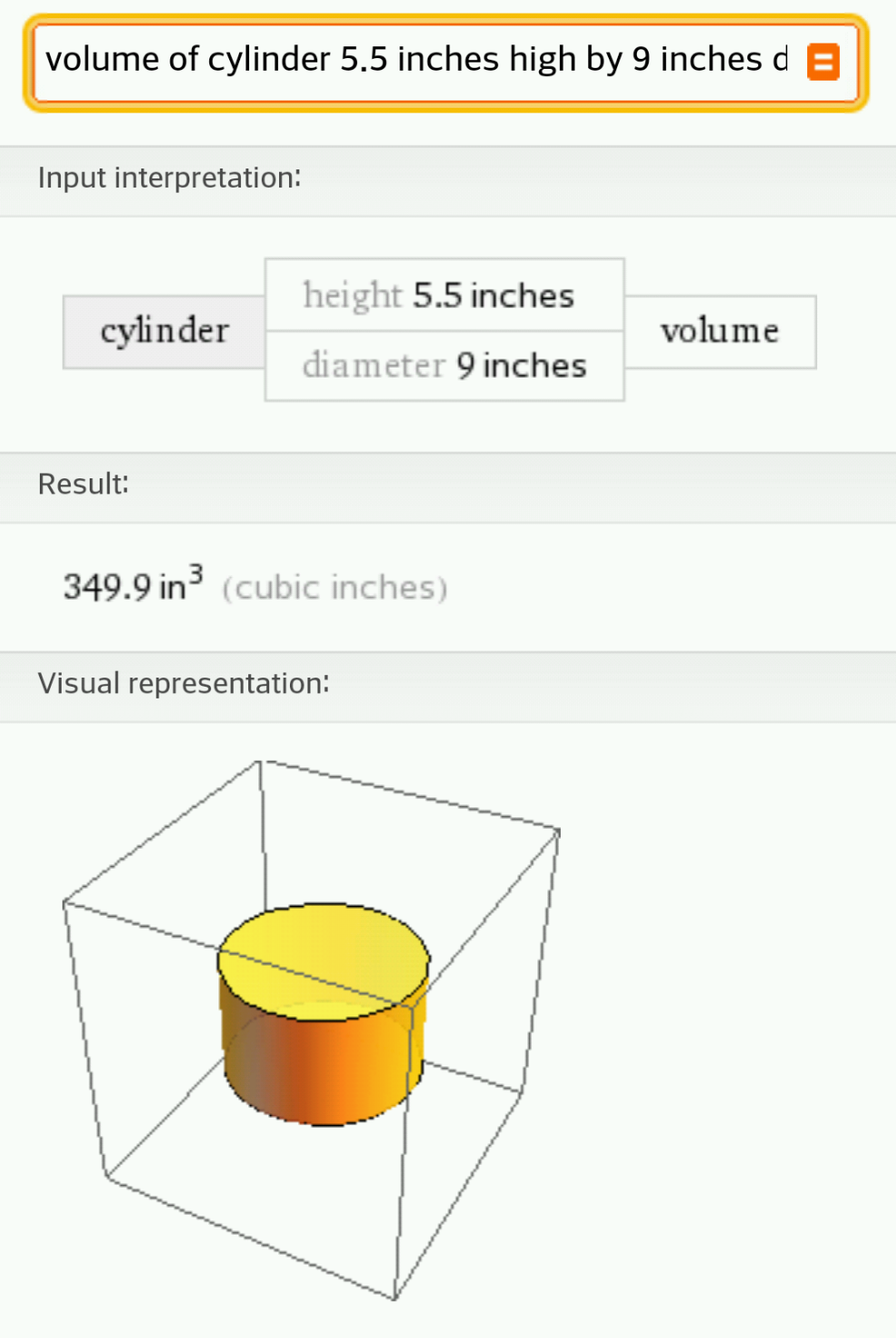
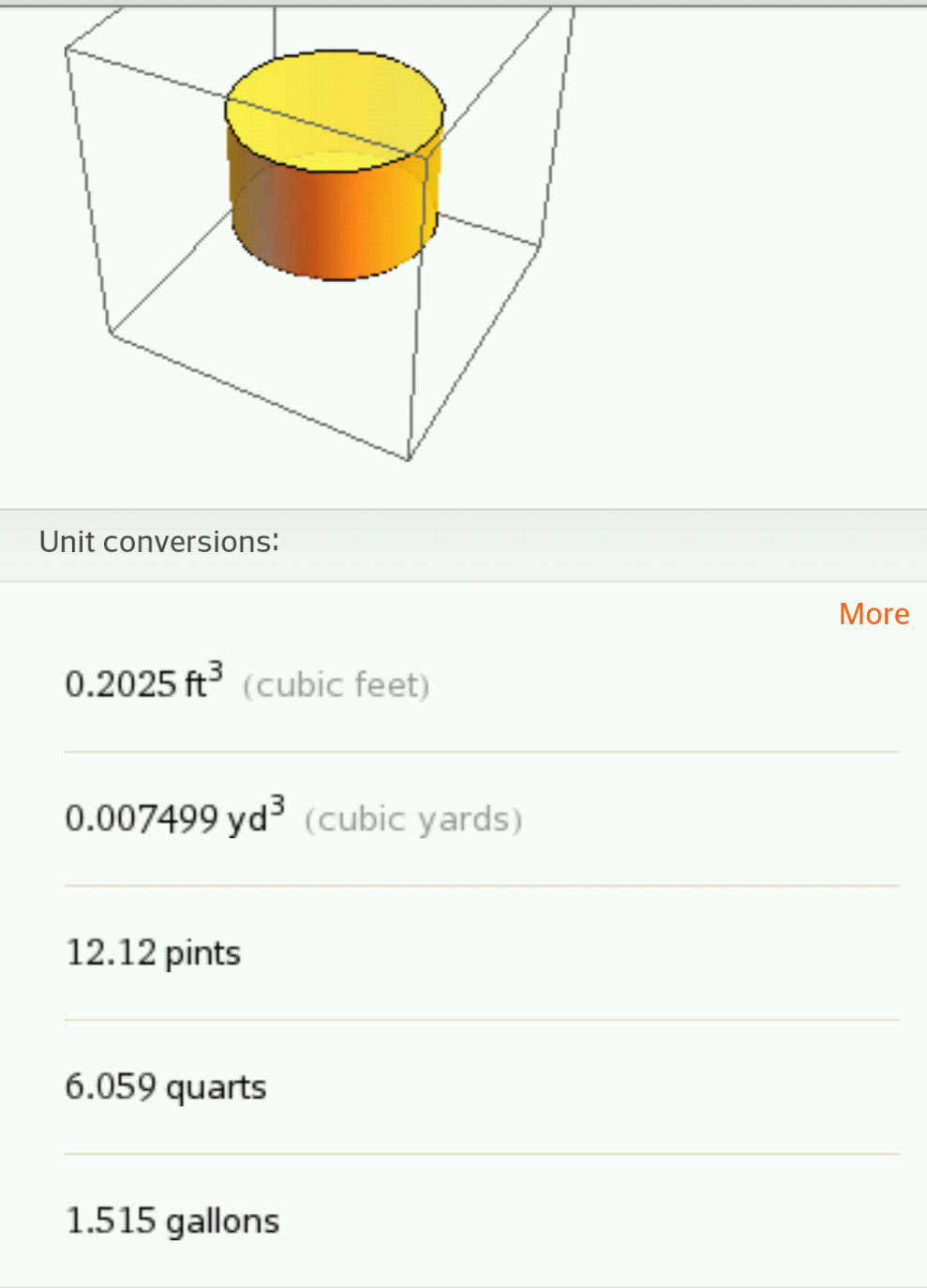
  3. Now all I have to do is calculate the volume of the stew cylinder. There are lots of online utilities that can do this, but I use Wolfram Alpha for virtually every mathematical calculation I have to perform in personal and professional life. You can enter what you want calculated in plain English, so I enter “number of cups in a cylinder 5.5 inches tall by 9 inches diameter.” Boom. Done. It tells me there are 6.06 quarts or just over 24 cups in my stew cylinder.
    Wolfram Alpha comes in very handy for stuff like determining the volume of a stew cylinder.

    Wolfram Alpha comes in very handy for stuff like determining the volume of a stew cylinder.

    This is the conversion table generated by Wolfram Alpha.

    This is the conversion table generated by Wolfram Alpha.

  4. Remember how I told MyFitnessPal that the pot of stew was one serving? This step is where it comes in handy. I can now make my serving size whatever I want. So if I want the pot to be 10 servings, I know that’s 2.4 cups (24/10). Now I can scoop 2.4 cups into my bowl and log it in MyFitnessPal by selecting the recipe and entering a fractional serving size, i.e. 0.1 servings since I’m eating a tenth of the pot. All my nutrients are calculated and added right to my daily totals. If I want to only have a cup of the stew, I simply divide 1 by 24 and get ~0.042, so that would be the serving size I enter into the application.

Determining the correct calories could also be accomplished by weighing the empty pot on a food scale, and then weighing it again once full of cooked food and logging the difference. Then you’d weigh the portion you wanted to eat and convert it into a fraction of the whole and enter it into MyFitnessPal as described in #4 above. The problem is that 1) my food scale maxes out at 5.5 lbs. and most of the stuff I cook plus the cookware is much heavier than that, and 2) the hot pot might melt the surface of the scale (mine is plastic).

Ripped Flavor Profile: Greek Yogurt with Fresh Orange Juice, Fresh Black Pepper, Cinnamon and Fennel

You could just go the simple route:

6-8oz plain Greek yogurt (I like full fat)
2-3 Tbsp fresh squeezed orange juice
6-8 grinds black pepper
Scant quarter tsp ground fennel
Cinnamon to taste
Touch of honey, if desired

or you could get creative and put this flavor profile to work in your own bigger recipe. Feel free to leave a comment about how you might remix these flavors.

There’s No Such Thing as Cheating

I see a good number of mentions of the concept of “cheating” during a diet. Many individuals who are cutting plan for what they refer to as “cheat” days or meals, a time during which eating guidelines are loosened. I never cheat because I don’t believe that there’s such thing as cheating when it comes to food. For example, I eat ice cream and chocolate and drink wine several nights a week. But it’s not cheating. How does that make sense?

According to Mirriam-Webster online, cheating is “to break a rule or law usually to gain an advantage at something.” Considering that, I see cheating in relation to whatever activity, whether it’s on an exam, on a spouse, in a sport, on a resume, or whatever else as just plain wrong. So then why would I program cheating into my lifestyle? If cheating provides an unfair advantage, how does eating “bad” or “dirty” food provide an unfair advantage? If anything, foods typically on the “cheat” list are nutrient sparse and sugary or fatty. Wouldn’t eating those things set a person back on the path toward their goals?

Here’s another question: assuming that there was some sort of pill that could make a person ripped overnight, providing a truly significant time advantage over getting ripped via traditional diet and exercise, would taking it constitute cheating? In my opinion, definitely not. Who would that person be cheating? Perhaps if he or she were competing in a “get ripped naturally” competition, then yes, but otherwise, it wouldn’t be cheating. It’s like saying that someone who has their stomach stapled is cheating to lose weight. So even if the logic of a “bad” food being a “cheat” held water (i.e. that it somehow was a hack for losing fat faster) the concept that it is cheating to hack a process that is unique to the individual and affects nobody else is illogical on its own.

All this is to say (if I hadn’t made my opinion clear already) that nothing about the concept of cheating with regard to food makes sense, which is why I don’t schedule cheat meals. They simply don’t exist in my mind. For me, a food is either ok to eat regularly, ok to eat occasionally, or not ok to eat ever. I’m not a proponent of the “If It Fit Your Macros” (IIFYM) paradigm, since I prefer to eat foods with a high nutritional content, but it’s still important to me to have some freedom to eat something less nutritious if I want it. For example, I enjoy having a serving of full fat, sugared ice cream a few times a week or 20-30 grams of 100% dark chocolate (yes, I love baking chocolate) with some red wine, but I would never eat, for example, a soy-based product, margarine, or a product sweetened with agave. I draw an eat/ no eat line and stick to it.

I also think that applying the concept of cheating to food can be detrimental because it puts a negative slant on the act of eating. It means that by eating that thing, you’re doing something bad or wrong. In my opinion, that’s the type of psychology that can provide conditions conducive to the development of an eating disorder.

How I reconcile eating less nutritious foods with my goals

On several pages across rippedforever.com, I explain that my philosophy about diet and exercise revolves around sustainability. Physique goes along with this; my interests are not in bulking and cutting cycles, since by definition that practice means that each condition is not sustained. My diet is part of my lifestyle, not something that comes to a halt, so maintaining it had better be as close to effortless as possible. I include less nutritious foods in my lifestyle because they allow relief from periods when I might be too low on calories or not be taking in enough fat or whatever. They provide psychological grease by effectively addressing the natural phenomenon of cravings.

Dietary Periodization

Just as I believe that the most effective lifting programs employ a periodization protocol that cycles the type of lift, load, set volume, rep volume, rep speed and rest interval at multiple scales (intra and inter-day, week and month) — see the RF Strength Method here, eating should be the same. Periodization in the gym is highly beneficial because it can help reduce fatigue, improve recovery, prevent psychological staleness, and reduce plateauing and stagnation. I find periodization as it relates to food consumption to be beneficial for the same reasons. I cannot eat below maintenance for months on end while lifting heavy if I want to slowly drop to 5% body fat. Although I might not adhere to the more strict periodization guidelines I set for my lifting, I might need a day or two each week to eat at my maintenance level to offer my body a break. I might need some good food high in naturally occurring saturated fat and cholesterol, like a few eggs cooked in a couple of tablespoons of lard to allow my hormone levels to reset. I might need an enormous bowl of oats with coconut oil and honey and dark chocolate to replenish glycogen stores sometimes. Ice cream is just something I love, so it’s a great psychological treat. Maybe I’ll have a double serving of red wine one night because I just enjoy the ensuing relaxed state. Does this sound like I’m doing something bad to myself (like a “cheat meal/ day” implies) or am I creating the ideal environment for mental and physical growth and progress? You know what I’d say.
Ripped Salad: Dandelion and Arugula with Honeydew, Prosciutto and Aged Provolone in a Warm Banana-Coconut-Bacon-Dijon Viniagrette

I like recipe names to be descriptive.

I’m also not fond of florid, 400-word descriptions of what a recipe tastes like. I’ll figure that out after I taste it. I just want to get to the good stuff!

But I will say that this bitter | salty | sweet freakshow of a salad is not only tantalizingly intriguing, but worthy of the “full meal” label. In fact, I just ate this for dinner. It’s my second favorite salad after the Vietnamese style arugula mint orange sardine one I posted a couple of days back, but only because it takes longer to prepare. Taste wise, they’re so different and both so freakin awesome.

What do these seemingly disparate ingredients have to do with one another? This salad. That's what.

What do these seemingly disparate ingredients have to do with one another? This salad. That’s what.

Ingredients
1:2 ratio of dandelion greens to arugula. I like to eat enormous portions, so I fill a family-size salad bowl. If you like it more bitter, up the dandelion.
1 wedge of honeydew, large diced
2 oz. prosciutto, sliced thin strips
1 oz. aged provolone, not the mild stuff
2 strips bacon (I prefer uncured organic stuff)
1/4 ripe banana
1 Tbsp good strong Dijon mustard
1 tsp virgin coconut oil
1.5 Tbsp or so of white wine vinegar (or whatever kind of vinegar you prefer)
1 Tbsp minced shallot
1 Tbsp bacon fat, reserved from pan
1 Tbsp unsweetened coconut flakes
Salt and fresh ground black pepper to taste

Preparation

    1. Put bacon on to cook until crisp in small frying pan (start it on the cold pan and let heat slowly).
    2. While bacon’s going, place greens, melon, cheese and prosciutto in large salad bowl.
    3. In a small bowl, smash ripe banana well with the back of a fork, then add mustard, shallot, vinegar and coconut flakes. Mix well.
    4. When bacon is cooked, pat dry with paper towel, chop, and sprinkle on salad.
    5. Add 1 Tbsp bacon fat from pan to bowl with other dressing ingredients, along with the coconut oil.
    6. Microwave dressing until just warm. Pour on salad and toss. Add salt and fresh pepper to taste. Eat.

Nutrition
~530 cal, 37g fat, 33g carbs, 22g protein (none of this really matters for getting ripped as long as daily protein intake is adequate)

How I Got Ripped Eating Fat… and Carbs (a calorie is AND isn’t a calorie).

Despite what some experts say, all my experience strongly points to the fact that losing fat boils down to energy balance i.e. calories in, calories out. There’s lots of internet discussion to the contrary about how carbs make you fat and how fat makes you skinny, but I completely disagree (I disagree mightily with guys like Gary Taubes); I don’t think any macronutrient is good or bad. I do strongly believe, and have through experience come to understand that certain types of carbohydrates stimulate some combination of physiological and psychological response that creates a desire to eat more of them, but it isn’t the calories in carbs themselves that are creating fatness.

Let’s say I want to eat a doughnut. Let’s also say it’s 400 calories, about all of which comes from flour and sugar. Should I be full? Definitely, because by the time I’m done eating one of my 400 calorie salads with meat and other stuff in it, I’m normally stuffed to my uvula. So then yes, this doughnut will fill me because it’s 400 calories, the same as the salad.

Obviously, this isn’t true (at least not for me); the salad is more filling because it’s bigger and contains a good macronutrient mix and fiber and all that good stuff. Accordingly, it doesn’t stimulate the severe insulin response that the sugar and flour in the doughnut does. Buuuut, they both contain the same energy. The real issue is that if I have the doughnut, I know I’ll have to white-knuckle the ensuing insulin-blood sugar roller coaster. It’ll make me want to eat more, but if I can hang on and not cave into doing that (pounding another doughnut), I’ll have consumed the same number of calories as I would have had I eaten the salad.

I think this pretty clearly illustrates how a calorie both is and isn’t a calorie. Energy wise, a gram of sugar and a gram of protein are the same. Similarly 36 calories from a few tablespoons of oats is the same as the 36 calories in 1/3 tablespoon of lard because each of those 36 calories requires the same amount of energy to be burned. But chemically, the foods (and molecules) with which those calories are associated can elicit wildly different hormonal responses and chemical reactions in the brain. This is directly connected with how we feel after we eat a certain food, like if it makes us feel full or slow or hungry or energetic or some combination of those.

Insulin response curves.

Since my diet is part of my lifestyle, and I’m not into white-knuckling my lifestyle, I’m definitely not into white-knuckling my diet, which is why I typically prefer not to eat sweets and things from boxes and bags (unless they’re carrots). I know how I react to calories from the wrong sources. Although I have great will power, I do my best to never have to exercise it.

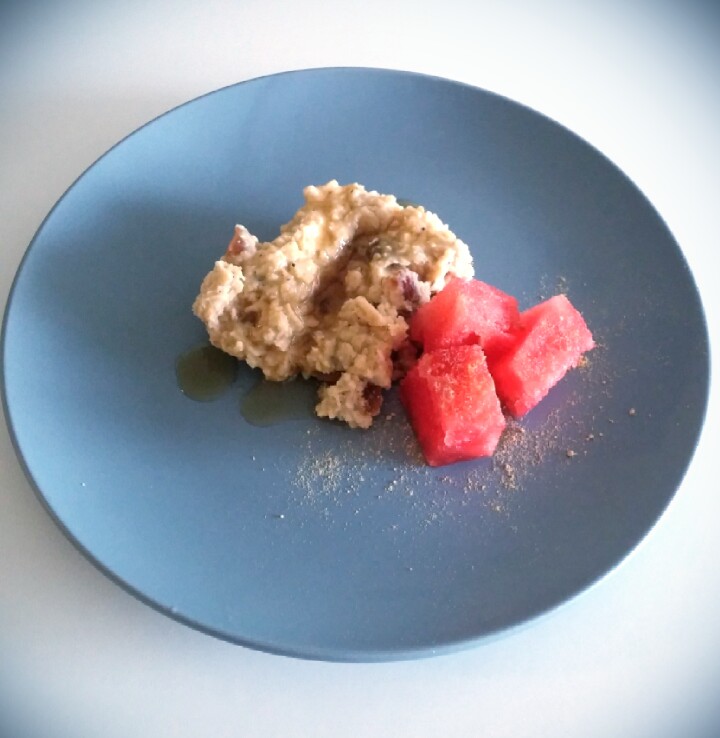
Ripped Recipe: Savory Garlic Romano Apricot Oatmeal Polenta With Ginger Dusted Watermelon and Maple Syrup

A truly unique twist on polenta.

A truly unique twist on polenta.

I enjoy polenta, but 1) I’m not into the cooking time, and 2) I don’t eat corn anymore. Sort of.

Anyway, I have a sneaking suspicion that most people believe oats are for breakfast (oatmeal), or dessert (cookies), or simply a flavorless filler/ moisture holder for meatloaf. Let’s smush that stereotype.

Ingredients
1/2 cup 1-min oats
1 cup unsalted chicken stock
1-2 Tbsp milk
3 Tbsp grated Locatelli Romano or other good hard Italian sharp cheese
1 small palmful of chopped dried apricots (preferably unsulphured organic)
1/2 tsp garlic powder
1/8 tsp nutmeg
salt and fresh ground black pepper to taste
watermelon cut into 1″ cubes
ground ginger

Preparation
Mix oats and chicken stock; microwave for a minute or so until the mixture becomes thick. This is half the liquid normally used to make oats.

Stir in Romano, apricots, garlic powder, nutmeg, salt and pepper. The mix should be very thick like corn polenta. If it’s too thick, just add a little milk.

Spread onto plate or tray and set aside or in fridge to cool. Once cool, it can be cut into squares, but they wont stay together like traditional polenta. You could alternatively just serve as a scoop on plate.

Plate by setting watermelon cubes next to polenta. Dust watermelon with granulated ginger. Drizzle a little pure maple syrup on oat polenta. Eat.