Author: DJS

How I Got Ripped Eating Fat… and Carbs (a calorie is AND isn’t a calorie).

Despite what some experts say, all my experience strongly points to the fact that losing fat boils down to energy balance i.e. calories in, calories out. There’s lots of internet discussion to the contrary about how carbs make you fat and how fat makes you skinny, but I completely disagree (I disagree mightily with guys like Gary Taubes); I don’t think any macronutrient is good or bad. I do strongly believe, and have through experience come to understand that certain types of carbohydrates stimulate some combination of physiological and psychological response that creates a desire to eat more of them, but it isn’t the calories in carbs themselves that are creating fatness.

Let’s say I want to eat a doughnut. Let’s also say it’s 400 calories, about all of which comes from flour and sugar. Should I be full? Definitely, because by the time I’m done eating one of my 400 calorie salads with meat and other stuff in it, I’m normally stuffed to my uvula. So then yes, this doughnut will fill me because it’s 400 calories, the same as the salad.

Obviously, this isn’t true (at least not for me); the salad is more filling because it’s bigger and contains a good macronutrient mix and fiber and all that good stuff. Accordingly, it doesn’t stimulate the severe insulin response that the sugar and flour in the doughnut does. Buuuut, they both contain the same energy. The real issue is that if I have the doughnut, I know I’ll have to white-knuckle the ensuing insulin-blood sugar roller coaster. It’ll make me want to eat more, but if I can hang on and not cave into doing that (pounding another doughnut), I’ll have consumed the same number of calories as I would have had I eaten the salad.

I think this pretty clearly illustrates how a calorie both is and isn’t a calorie. Energy wise, a gram of sugar and a gram of protein are the same. Similarly 36 calories from a few tablespoons of oats is the same as the 36 calories in 1/3 tablespoon of lard because each of those 36 calories requires the same amount of energy to be burned. But chemically, the foods (and molecules) with which those calories are associated can elicit wildly different hormonal responses and chemical reactions in the brain. This is directly connected with how we feel after we eat a certain food, like if it makes us feel full or slow or hungry or energetic or some combination of those.

Insulin response curves.

Since my diet is part of my lifestyle, and I’m not into white-knuckling my lifestyle, I’m definitely not into white-knuckling my diet, which is why I typically prefer not to eat sweets and things from boxes and bags (unless they’re carrots). I know how I react to calories from the wrong sources. Although I have great will power, I do my best to never have to exercise it.

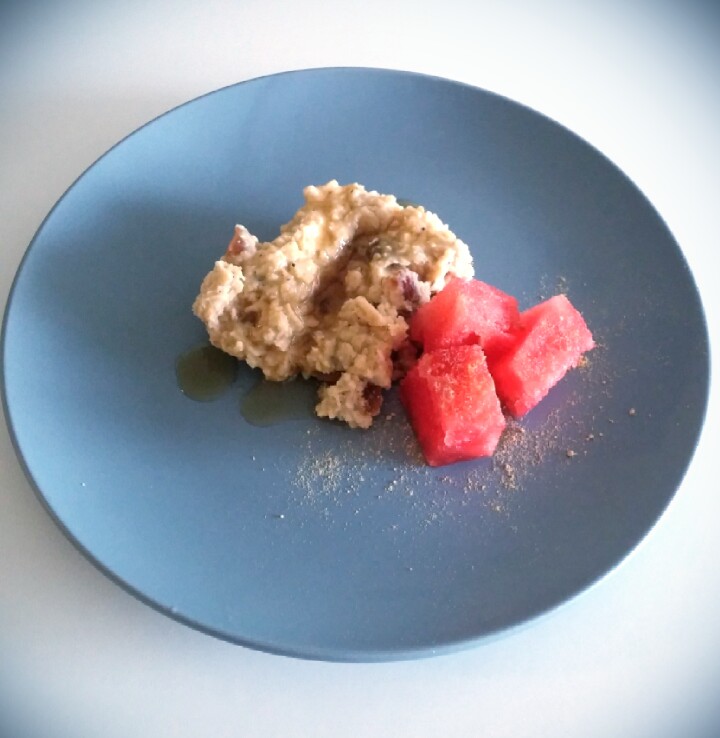
Ripped Recipe: Savory Garlic Romano Apricot Oatmeal Polenta With Ginger Dusted Watermelon and Maple Syrup

A truly unique twist on polenta.

A truly unique twist on polenta.

I enjoy polenta, but 1) I’m not into the cooking time, and 2) I don’t eat corn anymore. Sort of.

Anyway, I have a sneaking suspicion that most people believe oats are for breakfast (oatmeal), or dessert (cookies), or simply a flavorless filler/ moisture holder for meatloaf. Let’s smush that stereotype.

Ingredients
1/2 cup 1-min oats
1 cup unsalted chicken stock
1-2 Tbsp milk
3 Tbsp grated Locatelli Romano or other good hard Italian sharp cheese
1 small palmful of chopped dried apricots (preferably unsulphured organic)
1/2 tsp garlic powder
1/8 tsp nutmeg
salt and fresh ground black pepper to taste
watermelon cut into 1″ cubes
ground ginger

Preparation
Mix oats and chicken stock; microwave for a minute or so until the mixture becomes thick. This is half the liquid normally used to make oats.

Stir in Romano, apricots, garlic powder, nutmeg, salt and pepper. The mix should be very thick like corn polenta. If it’s too thick, just add a little milk.

Spread onto plate or tray and set aside or in fridge to cool. Once cool, it can be cut into squares, but they wont stay together like traditional polenta. You could alternatively just serve as a scoop on plate.

Plate by setting watermelon cubes next to polenta. Dust watermelon with granulated ginger. Drizzle a little pure maple syrup on oat polenta. Eat.

I used to think that walking was only for obese people…

…because ripped people did crazy cardio and metabolic training. P90X. CrossFit. Boutique bootcamps. I was one of them. An 18-mile run on a Saturday morning was just the way I woke myself up. Jump squats. Fifty burpees. Repping out on TRX bands. Heavy ropes and jump ropes and more running. Sprinting! A half hour of sprints! No, make it 35 minutes! Walking was exercise for grandparents, the sick, the recovering, the fat and the lazy. I scoffed at the Surgeon General’s recommendation that every capable individual walk at least 10,000 steps per day. How pointless. My view was that walking only counted as exercise for the overweight. Except for the minor detail that I had it all wrong.

My first several days of not performing any structured cardio required an act of brute force will that I was seriously unaccustomed to. I was addicted to brutally difficult, gut-busting metabolic work and grueling endurance activities. I literally ran 20 miles for fun on some days. I was going hard seven days a week. Weekends were “awesome” because I got to spend more time burning myself. I’d complete a workout (i.e. a body mutilation session) on a Saturday, get home, shower, and be totally blown for the rest of the day. Playing with my son took every last ounce of energy I had. I felt like my body temperature was perpetually elevated. On weekdays, I’d blast my body early in the morning to the extent that I’d be dripping sweat for the next several hours. Let me tell you, if there’s something more unprofessional in a business meeting than huffing out a big, flappy fart, it’s having to wipe your upper lip and brow every 90 seconds because your body is doing all it can muster not to spontaneously combust as a result of a stupid-ass workout.

On the first day that I didn’t go to the gym in the morning in favor of taking a walk outside, I felt like an alien in a strange new world. There was fresh air. The sun was rising. I was one of the first people out on the street (6am); the city had a different feeling at that time. I didn’t need music to walk. I listened to NPR (National Public Radio) instead. Education while exercising? Wow. But was it actually exercise? My heart wasn’t pounding. I was barely breathing. No burning in my muscles. Just… just… easiness. The walking motion felt simultaneously so familiar, yet so foreign. Until that time, I’d been doing this walking thing out of necessity. Since my family and I live in the city and don’t own cars, walking is just a mode of transportation (along with biking/ longboarding/ subway). But now I was doing it without a place to go.

And I enjoyed it.

Fast forward to present day. I can, without reservation and with a clear mind say that I not only enjoy walking for pleasure and exercise, but I have actually come to love it. Yes, I used the L word. Now, it’s the only form of cardio I perform. I do it on both lifting and rest days, and my FitBit One has become such an instrumental piece of fitness equipment for that reason. Because it tracks steps and integrates with MyFitnessPal, it motivates me like nothing else.

There are so many reasons why I love walking

1) It helped me get ripped

I am religious about walking at least 10,000 steps (about five miles) on a lifting day and 12,000-13,000 (about six miles) on a rest day. That might sound like a lot, but spread out over the course of a day, it’s really not at all. All those steps add up to 400-600 calories daily, which, in addition to intermittent fasting enables me to easily maintain a daily caloric deficit that has been and continues to be conducive to my ripped goals. For me, learning how to get ripped meant learning how to walk.

2) I have lots more energy

I find the act of walking itself to be energizing, but what’s even more beneficial for me is how it doesn’t leave me feeling wasted and hungry like traditional cardio and metabolic training.

It’s low impact and very low stress

Call me nuts, but I believe that humans are built to walk before anything else. I don’t think that running for long distances is natural to us. Sprinting occasionally, yes. I am an experienced endurance runner. The reasons I enjoyed running were less physical than they were mental. I enjoyed the feeling that I had completed a mini-odyssey after a 25 mile run, in addition to the mental challenge. But physically, that endurance stuff wreaked havoc on my body. Tightness everywhere, aching joints, lots of sweating, dehydration. What I was doing was so unhealthy. Walking is the opposite. When I dropped hard cardio, I also noted a marked improvement in my immunity. I’ve read that too much intense cardio can impair immune function by reducing white blood cell count as well as chronically increasing stress hormone levels. A big part of learning how to get ripped entailed learning how to stay healthy so that I could maintain my productive gym work.

Walking lets me spend less time inside gym

The gym is a petri dish rife with who knows what strains of freakish Franken-microbes. This goes to the point about immunity above.

Walking has improved my mobility

Since I have a daily step goal and I don’t take all 10,000 or 12,000 steps in a single bout, I get up and walk a few times per day. This is powerful for two reasons. In the olden days, I performed hard cardio and/ or CrossFit style stuff early in the morning, biked to work, then sat at my desk for seven or eight hours. So basically I was saying a big “screw you” to my muscles, muscle facia and tendons. The repetitive fast contractions of the muscles associated with all that cardio and plyometric/ CrossFit/ metabolic work caused tightness throughout my body, and then I sat frozen in a position that’s conducive to generating tightness all on its own. Does that sound smart? Walking fixes all that. First, it’s low-impact and doesn’t cause the tightness endemic to high-impact stuff. Second, it’s spread over the day, meaning that I can’t stay seated for all that time. A win-win if you ask me.

Walking lets me spend more time with my family

Here’s what a Saturday or Sunday used to look like for me: destroy body at gym. Make little progress. Get home. Shower. Muster every last drip of energy interacting with family. Drag myself around outside with them. Collapse at end the of the day.

Now, it looks like this: if it’s a gym day, lift according to the RF Strength Method, spending no more than an hour in the gym. Get home. Shower. Energetically engage with family. Walk to park. Play with son in park. Walk around the neighborhood with family. Walk home with family. That’s all my “cardio” now.

Walking can be done virtually any time with no equipment

I don’t really have to explain this one. A couple of days per week, I don’t achieve my step goals by the time I get home. OMG!! What to do?! Walk back and forth in the apartment for a while, while pondering how to create a cohesive meal out of fish heads, lard and oatmeal. Literally. Jog lightly in place for a few minutes here and there until my FitBit tells me I’m good. It all counts. It’s all energy out. No sweat.

Ripped Dessert: Cinnamon-Cayenne-Fennel-Spiked Chocolate Coffee Coconut Protein Balls

Part of my process of learning how to get ripped was to learn how to think even more creatively about food. Although I call this a dessert, it’s not sweet by dessert standards, but it’s a neat little protein snack and a flavor excursion.

A sneaky trio of cayenne, fennel and cinnamon set these chocolate coffee coconut protein balls off!

Ingredients
1 scoop (34g) chocolate casein protein
4 tsp coconut flour
3 tsp instant coffee
5 Tbsp milk
2 tsp virgin coconut oil
1/2 tsp vanilla extract
1/4 tsp cayenne pepper
1/4 + 1/8 tsp cinnamon
1/4 + 1/8 tsp ground fennel
1 gram stevia
1/2 to 1 tsp honey
2-3 Tbsp coconut flakes

Preparation
Mix coconut flour, milk and instant coffee in small bowl with stevia and sugar or honey. If you don’t like stevia, you can sub in a little more sugar or honey. I prefer honey because it adds a bit more moisture.

Add protein, cayenne, cinnamon, and fennel along with the coconut oil. Mix well until it forms a sort of doughy paste. Form into balls. Roll in coconut flakes. Eat.

~230 calories, 26g protein, 10g fat, 4g carbs

A couple of notes:

  • If you really want to go berserk, I think you could probably smash some banana and mix it in. It might require a little more coconut flour to keep it tight though.
  • In case you were wondering, since it’s just finely ground coconut meat, coconut flour doesn’t have to be cooked.
  • If you’re going to make this, you can play with the amount of coffee. Also, I know that some individuals aren’t fond of stevia because it can be a little bitter. If that’s the case, add a little extra honey.
  • Vanilla casein can also be swapped in for the chocolate casein.
  • I wouldn’t try using whey protein for this. I’ve found that whey really doesn’t work well with recipes because it doesn’t gel the whey casein does.
  • Try swapping the fennel for ground coriander.

Ripped Salad: Vietnamese Italian Spinach Arugula and Mint with Sardines and Oranges

I know, I know. That recipe title is a mouthful. And so is this incredibly delicious and unique salad. This is completely my own creation, and it’s my favorite salad ever. Vietnamese and Italian flavors are combined with oranges and sardines to create an incredible flavor profile. Perfect for a first recipe post.

These ingredients combine to create a unique and delicious flavor profile.

These ingredients combine to create a unique and delicious flavor profile.

Ingredients

  • For the salad:
    • Several handfuls each of organic baby spinach and arugula.
    • One quarter of a large navel orange, sliced
    • A half cup of roughly torn fresh mint leaves
    • One half of a cucumber, sliced, peeled or unpeeled, but peeled if not organic
    • 3 Tbsp Grated Locatelli Romano cheese or any other sharp, hard Italian cheese (Romano, parmiggiano regianno, etc.)
  • For the dressing:
    • One can of sardines (I only buy in extra virgin olive oil or water, never soybean or other vegetable oil)
    • 1 Tbsp black or white sesame seeds, toasted in a dry pan for a few minutes
    • 3 Tbsp of one or a combination of apple cider vinegar (preferably raw unfiltered), rice wine vinegar, or white vinegar
    • 2 tsp Thai fish sauce (can be found in the international aisle of any decent grocery
    • 2 tsp soy sauce (I prefer to use reduced sodium)
    • 1 tsp Sriracha
    • 1/2 tsp toasted sesame oil
    • 1 tsp garlic powder
    • 1 tsp red chili flakes (or to taste)
    • 2 tsp of one or a combination of dried Thai basil or sweet basil
    • 1 tsp brown sugar

    Preparation
    Add greens, oranges, cucumber and mint to salad bowl.

    Begin the dressing by roughly smashing the sardines in a bowl. Add the rest of the ingredients and mix well. Spoon over greens/ oranges/ cucumber/ mint mixture. Sprinkle with grated cheese. Toss well and enjoy.

    ~280 calories, 20g protein, 15g fat, 5g carbs

Ripped Forever: Launching Soon

The majority of content on this site will be available by June 16, 2014.

Hi. My initials are DJS. This writing is about how to get ripped, and more importantly, how to stay ripped (or, at least how I went about it). I’m normally an extremely private person. I don’t use Facebook or Twitter, and I’ve never left a comment on YouTube. I’ve never sent nude photos of myself to anyone. I’m exceedingly protective of my phone number and email address. I prefer not to take my shirt off in front of anyone other than my wife. I have decided to post shirtless photos of myself on the main page of this blog; needless to say it was a complicated decision. But the reason I’ve decided to do it is to demonstrate a physical transformation that I think many people believe is difficult to achieve, and especially to maintain. In practice, I found that getting ripped and staying ripped can be accomplished with legitimate ease and comfort. With a moderate reconfiguration of my lifestyle based on a lot of reading and years of experience learning how to get ripped the very hard and counterproductive way, I figured out how to get ripped in only a few months with relatively little effort, and more importantly, how to stay ripped.

I’m not asking for donations, nor am I selling something. I’m certainly not revealing the newest “secrets” about how to get ripped in a book for a limited time only. I’m simply sharing my story and experience with anyone who is interested because I’ve experienced real results. I think others might find it helpful in achieving their own goals.

A little about me

I’m in my early 30s, and am a native and resident of Brooklyn, NY. My family on both sides goes back for three generations here. I live with my wife and son. I work in an office managing a team of great analysts, studying things and solving interesting problems. I am also the founding director of a nonprofit dedicated to simplifying volunteer management during emergencies. I’ve always been quite interested in nutrition, anatomy and fitness since I was a kid (sort of weird). Out of a personal interest, in 2011 I was credentialed by the National Association of Sports Medicine (NASM) as a Certified Personal Trainer and took clients as a hobby, but am no longer certified since I do not have the time to take continuing education courses. Nevertheless, my deep interest in nutrition and physiology remains strong. I would not necessarily consider myself an expert in either though… more of an enthusiast.

How this blog is different

There are several blogs out there about how to get ripped, but this one is a bit different in both tone and form. You might notice (if you choose to read more once content is posted) that I generally won’t prescribe advice, make sweeping statements, or say to “do this” or “do that”; in my opinion, there are too many internet experts. Although I do believe I possess a deeper knowledge of this subject matter than the average person, I frame most of the techniques I discuss in terms of how they helped me, but it doesn’t mean that you must use them too and that if you don’t you’re a fool. There are many blogs/ boards/ forums about how to get ripped that are mean spirited and unnecessarily critical of individuals who do not agree with their ideas or don’t adhere to a certain lifting routine or philosophy. My belief is that most people in the gym or visiting this site (or those like it) are doing so in an effort to improve themselves in some way, and that’s a good thing. The way they’re currently doing it might not be as effective as the way I or someone else does it, or they might have a different goal, but that’s not for me to be concerned with; I have found that I experience my greatest successes when I direct my energy and focus into what I’m doing rather than what others are doing, which is why I frame most of what I discuss in terms of my own experiences.

This site is simply host to a description of the techniques I used to accomplish my goal of getting ripped and staying ripped. You might consider incorporating all, some, or even none of them into your own path learning how to get ripped. However, since I do believe that getting ripped and staying ripped requires a holistic approach, incorporating only a few of these techniques might not yield the same results for you. Whatever the case, I hope you can find something positive or informative on this site. Please do feel free to comment and/ or ask questions (respectfully, of course).

A little history about my quest to get ripped

I have been conducting some sort of physical training for twenty years, but I only got moderately ripped for the first time in my early-mid 20s, and I did it the very hard and counterproductive way. During that time, I knew a really well muscled, ripped guy in the gym I was a member of then. I needed to know how to get that ripped. When I asked him how he did it, he told me, “really hard cardio.” Because he was ripped, I accepted that as the only truth. It’s clear to me now that not only did he leave some information out, but also that “really hard cardio” is one tool that some people might use, but that I absolutely did not use to get ripped.

In any case, being the gung-ho (and overly eager) kid that I was at the time, I took his pronouncement as gospel and made it my life beginning the next day. So in addition to lifting six days per week on a three-day split, I also began performing metabolic work including high intensity interval training (CrossFit type routines), and running at a fast pace (I’m talking a 6-minute mile for 20-25 minutes) several times a week. My mindset was that if I wasn’t burned out at the end of a workout, if I didn’t experience a pump in whichever muscle groups I was working that day, and if my t-shirt wasn’t saturated with sweat, then I hadn’t done enough that day toward my goal of getting ripped. In retrospect, I’m surprised that I even took off one day per week. What I had to show for all that grueling work was 9% body fat (which in my opinion isn’t particularly low) and some new muscle, but it was so damn hard to get to that point. And worse, more often than not I had a dreadful feeling that my condition was balancing on a knife’s edge, and boy, was I was right; after only eight months the supports came out. The daily exhaustive grind caught up with me in a big way. Not only was my body always tired, but I was mentally drained as well.

Flash forward a decade and here I am again. During a time when extraordinarily draining and complicated CrossFit and P90X and Insanity workouts are widely touted (at least in the media) as the keys to developing a ripped physique and burning fat, I ignored them and learned how to get ripped through a process that seemed almost effortless. I still shake my head in disbelief thinking back at how I much time and energy I put in ten years ago compared to quite literally less than 20 percent of that now, yet how now I’m significantly more ripped and feel so much fresher and looser than I did then.

How this site will be organized

Rather than only providing a list of topics or articles, I thought that an outline highlighting the points and practices that I believe were most relevant to my own transformation would be more intuitive and useful for those who choose to read further. I don’t claim it’s the best way, and it’s not the only way, but it was very effective for me and the lifestyle changes required were comfortable and actually enjoyable. My primary concern was that once I got ripped, I would be able to stay ripped indefinitely and with little thought and effort.

During the process of getting ripped this time around, I dropped from 13% body fat to below 8%, which equated to nearly 9 lbs of fat, but the scale only reflected a 2 lbs decrease, meaning that I simultaneously added 6 lbs of muscle. This is often referred to as a “recomposition”. I will repeat that my transformation wasn’t difficult; it was slow, comfortable and methodical.